
"A wealth of information creates a poverty of attention." -Herbert Simon

From market noise to high-frequency intelligence: Lessons from our Competitive Analysis Agent.
Introduction
We live in a unique time, defined by the free flow of information. The benefits of the democratisation of human knowledge have been enormous, fuelling an unprecedented leap in global productivity and innovation – but we’ve only scratched the surface of what’s possible. Since the mid-20th century, we’ve exponentially expanded our knowledge base and done a fantastic job of storing it all, but the complexity has grown beyond our control.
Decades before most of us had a smartphone in our pockets, thinkers were already aware that our human brain,, the most sophisticated biological computer known to exist, has a finite capacity. The term “information overload” first appeared in the early 1960s. Even then, barely at the dawn of the information age, we were asking how we would deal with the relentless torrent of information that was to come.
It turns out these forward-thinkers were right. We have seen indisputable proof that the Digital Age has reshaped our neural pathways and impacted our collective mental well-being. While the benefits definitely outweigh the costs, we have reached a simple conclusion: we have engineered a global information boom without a corresponding expansion in our own internal hardware, leaving our ancient, finite processors to drown in an infinite digital ocean.
More than half a century later, we’ve finally established a solution – a machine that doesn’t just store and process information – something that helps us reduce the complexity of it: Artificial Intelligence.
We’ve built agents that can synthesise vast amounts of data in the blink of an eye and perform repetitive, high-volume tasks without getting tired. Using AI for these kinds of straining functions can bring human cognitive power back to where it functions best: strategising, innovating, and empathising. By using the appropriate intelligence tools for each job, we can catalyse the next generative leap in human productivity – the likes of which we haven’t seen since the dawn of the digital age.
From Scarcity to Overload
Access to information has always carried many distinct advantages: those with more knowledge could strategise, inspire, invent, navigate, or earn better than those who had less. For most of human history, this disparity has been pronounced. Knowledge was a high-friction resource; it was scarce and highly coveted. Consequently, it was only shared with trusted apprentices, loyal disciples or well-paying students. Information had a cost, and a strong influence on the social hierarchy.
Then, in the mid-20th century, the floodgates opened. The invention of the internet, digitisation of information, increasing global communication, and cultural movements have fundamentally changed the way society produces, values, and uses information. While the desire to control information never really went away – companies still guard their intellectual property, censorship still exists, and platform algorithms influence what you see – the friction blocking its flow has been dissolved, and information has become almost free.
The benefits were real and significant: new industries, opportunities, and economic growth started to explode. People became more aware of what was really happening in the world, increasing cultural understanding across borders and shining a light on inequality. Individuals now had a voice – they could share their opinions, grow a following, and participate in culture or innovation.
But once we solved the problem “how do I find out?”, we were left with a new question: “how do I filter out?”. The brain, having evolved in a world of scarcity and survival, has developed a novelty bias, paying attention to anything new because it was likely to be important. Applying this logic to the modern information landscape has caused our filters to become overwhelmed and exhausted. We have moved from having to hunt for knowledge to having to defend against irrelevant, inaccurate, or overwhelming information.
 The Cognitive Tax
It’s not that we have damaged our brains with information overload – the brain is highly adaptable, but adaptable doesn’t mean unlimited. So far, we have been navigating the digital age through brute force, using the wrong tool. We’ve forced our brains to adapt to a frequency of input that they never evolved for.
The problem we face is an unmanageable signal-to-noise ratio. The valuable, actionable insight is increasingly buried under a deafening amount of trivial, distracting, and redundant information. Trying to filter out the noise takes a huge amount of metabolic energy that is, at best, inefficient and, at worst, unproductive. Research shows that there is a physical, ATP-level cost for every bit of data your neurons have to sort. Filtering noise is quite literally draining you physically and mentally.1
This constant, high-stakes filtering is what creates the cognitive tax. We have gained access to more information than any generation in history, but we pay for it with the very faculties required to use it. When the signal-to-noise ratio is this poor, we see measurable trade-offs:
- Dampened Decision-Making: "Analysis paralysis" sets in as the brain struggles to weigh too many variables at once.2
- Fractured Focus: Average screen-based attention has plummeted to just 43 seconds, while the "recovery cost" to return to deep work after a distraction has risen to nearly 27 minutes.3
- Reduced Evaluative Thinking: When we are drowning in noise, we tend to react rather than reflect, losing our ability to critique the information we consume.4
- Biological Friction: Reduced sleep quality5, shortened attention spans6, and increased general anxiety.7
We can’t put the genie back in the bottle, nor should we want to. The democratisation of information is too valuable, generative, and fundamentally useful to reverse. But we have reached the limit of what we can achieve through human effort alone. We need a cognitive pre-processor, which is where AI comes in. We’ve finally built the perfect tool for the frequency problem: by absorbing the cognitive tax with an intelligence system that was specifically designed to handle it, we free up human mental function to execute where it does best: strategy, innovation, and connection.
Case Study: Our Competitive Analysis Agent
The thought behind this piece originated with a Competitive Analysis Agent we developed for the telecommunications industry – a sector defined by extreme market volatility and a noise level that frequently drowns out strategic signals.
While the underlying architecture is industry-agnostic, the Telco application illustrates the power of a cognitive pre-processor. The agent is designed to ingest massive volumes of unstructured market data: retail pricing shifts, evolving financial regulations, and complex supply chain fluctuations.
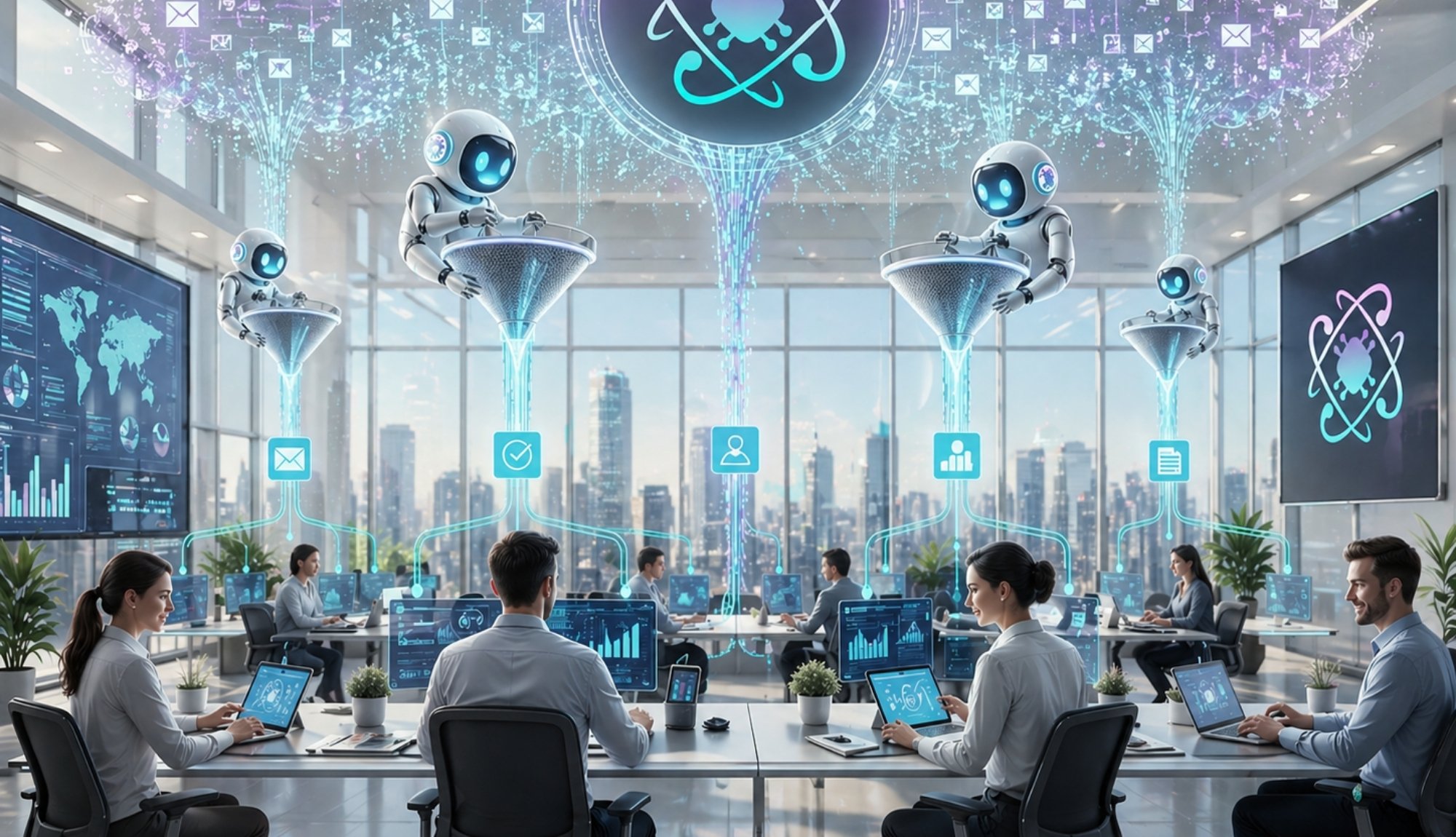
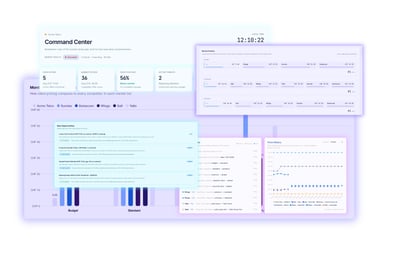 In practice, the agent does several things. It tracks competitor price changes in real time and formats this information into interactive dashboards that show your market position and key threats. It then provides your team with prioritised action plans and breaks them down into immediate priorities, Monday morning checklists, new opportunities and an implementation roadmap. An integrated intelligence assistant allows non-technical team members to query the entire knowledge network in natural language — asking, for example, how a 15% price increase might affect market standing, or which competitor is most likely to disrupt pricing in the next six months.
The overall impact is a “cognitive refund”. Teams spend less time gathering and processing information and more time taking action. Employees are freed from the repetitive, draining analysis kind of work that the information age has quietly imposed on them. Companies become more productive, and individuals spend more time on what they’re best at – work that keeps them feeling engaged and fulfilled.
The Burning Platform
This is where the shift becomes necessary rather than optional. We should look to the analogy of algorithmic trading as the "burning platform" for the rest of the business world. In the financial sector, once the first movers adopted algorithmic processing, the speed of the market accelerated beyond human biological capacity. The floor trader didn't just become slower; they became obsolete.
Now, we are entering the era of High-Frequency Intelligence. Leading corporations will use AI agents to synthesise global regulation changes into a strategy in seconds. If your team is still manually processing information, you aren't just behind – you’re dead last.
This "burning platform" is fuelled by three converging pressures:
- Speed Gap: With 88% of organisations now deploying AI across core functions8, the baseline speed of the economy has shifted. Business cycles that once took months now resolve in days.
- Compliance Tax: With increasing regulation, such as the EU AI Act on the horizon, the sheer volume of required "High-Risk" documentation will make manual governance impossible without an agentic pre-processor.
- Talent Drain: Top-tier talent will no longer be willing to pay the cognitive tax, preferring to migrate to firms where agentic systems handle the noise, leaving them free to focus on high-stakes strategy and innovation.
Individual empowerment doesn't just improve the corporation; it raises the baseline speed of the entire economy. The question for leaders is no longer whether to adopt these tools, but how much cognitive tax they are willing to pay.
Back To Human Value
For the last 40-50 years, humanity has been sitting on the largest reserve of available information in history, but has largely been overwhelmed by it, because the right processing infrastructure wasn’t in place. We can think of this knowledge like unrefined fuel: massive potential energy for innovation, productivity and accomplishment, but with no guaranteed payoff. Without the right engine to burn it, most of that energy is wasted, lost or rendered ‘stale’ before we can use it.
Until now, the human brain has been the only engine – brilliant, but fundamentally limited and inefficient compared to the scope of the potential output. We found a workaround: by pooling our cognitive capacity in corporations, institutions, and universities, we could combine our capacity and achieve what no individual could alone. But that meant many of these human brains ended up as small cogs in large intellectual machines, spending their time performing the metabolic drudgery of sorting, summarising, and reporting – vital roles, but ones that people were ultimately unsuited for and often found unfulfilling.
Agentic AI fundamentally changes this dynamic. Enabling individuals to achieve, alone, what previously required an entire organisation. It’s the difference between feeding coal into a shared industrial furnace and having your own personal fusion generator. When an individual has access to an agent that handles the high-frequency processing, the scope of possibility becomes exponential.
This is what we mean by the Human Value in Work. Not just productivity gains or cost savings, but a genuinely democratised exponential growth in output. We are moving the focus of human energy back towards deep creativity, ethical judgment, and complex strategy – things a machine can support but never replicate. The digital revolution gave us the information; the agentic revolution finally gives us the power to use it.
Conclusion
For most of human history, information was scarce and tightly controlled. Power belonged to those who held it. The information age changed all of that, throwing open the floodgates and placing the sum of human knowledge within reach of anyone with a connection. But potential energy is not the same as output. Without the infrastructure to process it, most of that energy was wasted. Now that we are building that infrastructure, the momentum it unlocks may result in the most significant leap in human productivity since the digital age itself.
As we have seen with our Competitive Analysis Agent, the value of AI is not in its ability to speak, but in its ability to assimilate. This is no longer a luxury – it’s a burning platform. In a world where an agent can synthesise a global strategy in seconds, the manual processing of information is no longer a viable business model.
However, this shift does not signal the end of human relevance; it’s a promotion from data processor to architect. Consider a typing pool in the mid-20th century: when technology made the typist obsolete, it didn’t end corporate collaboration; it made every employee an autonomous communicator. Agentic AI is the same moment for the human intellect. By offloading the metabolic drudgery of data processing, we aren't losing work; we are reclaiming the Human Value in it, and empowerment at the individual level brings exponential gain at the collaborative level.
Whether we are moving into a new agentic era or have only just cracked the surface of the information era remains to be seen. What is clear is that we are at a transition point, and the shift will be unforgiving to those who hesitate.
Ref.
- https://www.researchgate.net/publication/13103307_The_metabolic_cost_of_neural_information
- https://gc-bs.org/articles/the-impact-of-cognitive-load-on-decision-making-efficiency/
- https://gloriamark.com/attention-span/
- https://blogs.ucl.ac.uk/digital-education/2010/02/21/what-is-the-google-generation/
- https://www.cambridge.org/core/journals/european-psychiatry/article/acute-effect-of-blue-light-exposition-on-wellbeing-and-melatonin-secretion-in-humans/C3D67F160038B6E202703C41EDCFD201
- https://blogs.ucl.ac.uk/digital-education/2010/02/21/what-is-the-google-generation/
- https://osha.europa.eu/en/facts-and-figures/osh-pulse/climate-digital-change
- https://hai.stanford.edu/ai-index